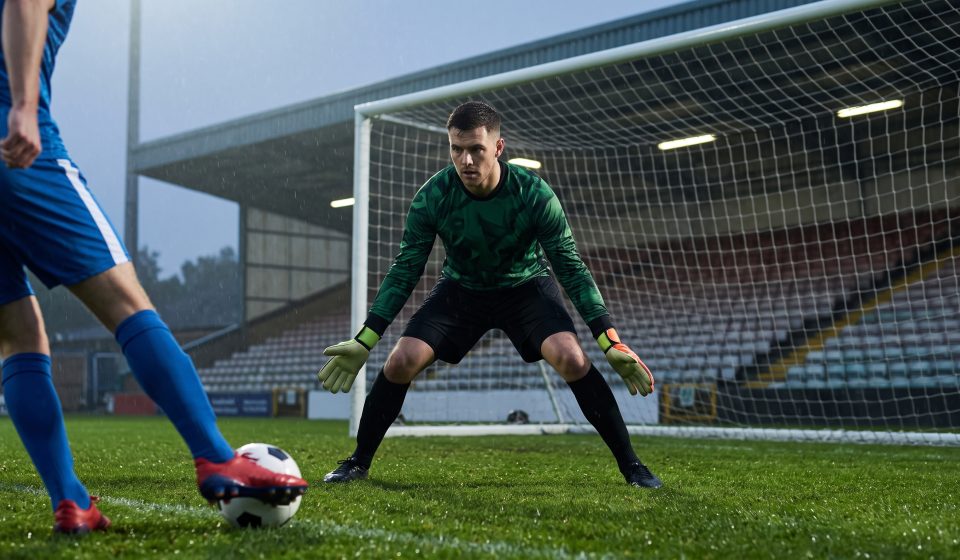

Saving a one-on-one relies on managing distance, angle, and timing rather than guessing where the striker will shoot. When an attacker breaks through, you must close the space quickly, decelerate as they prepare to strike, and get into a balanced set position before they make contact. If the attacker takes a heavy touch, slide in with a smother; if they are inside eight yards with the ball under control, deploy a barrier shape such as the futsal-inspired K-block or star spread. Committing early or diving forward while the striker is striking will almost always leave the net exposed.
Understanding the Geometry of the 1v1
A one-on-one is fundamentally a game of angles. The moment an attacking player gets behind the defensive line, your goal is to shrink the visible target without taking yourself out of contention.
Every step forward narrows the amount of goal the striker can see. However, running continuously toward the ball makes you vulnerable to being rounded, chipped, or wrong-footed. Modern goalkeeping divides the defensive box into distinct operational zones where specific technical choices must be applied.
| Zone & Distance | Attacker Situation | Primary Technical Action |
|---|---|---|
| Beyond 15 yards (Entry Phase) | Uncontested run toward goal | Fast forward travel; track the ball line; prepare to decelerate |
| 9 to 14 yards (Deceleration Phase) | Striker preparing strike or second touch | Shorten strides; set on toes; hold position until the striker commits |
| Inside 8 yards (Strike Zone) | Striker shooting under close pressure | K-block barrier, star spread, or reaction foot save |
| Any distance (Heavy touch) | Ball runs loose beyond attacker’s reach | Low forward dive to smother at the feet |
The Three Core 1v1 Saves Explained
1. The Traditional Smother
The smother is an aggressive recovery save executed when the attacker takes a heavy or miscontrolled touch. Rather than waiting for the striker to gather themselves, you attack the loose ball with your hands, sliding through the line of the ball with your torso positioned directly behind the capture point. Leading with the head and upper body while maintaining low hip height ensures the ball cannot slip beneath your chest.
2. The Futsal K-Block
The K-block has become the standard technique across elite modern goalkeeping for tight-angle entries and strikes taken from six to ten yards out. To execute a K-block, drop the trailing knee flush to the turf right against the heel of your lead foot. This completely seals the five-hole (between the legs) while keeping your torso upright and your hands wide and low to cover near-post tap-ins and cutbacks.
3. The Star Spread
When an attacker receives a central chance within six to eight yards, human reaction time is insufficient to track the ball’s flight path after it is kicked. In this split-second scenario, the star spread maximizes your total physical surface area. You extend both arms sideways and slightly downwards, kick one leg outward, and maintain an upright chest, creating a wall that forces the striker to find an improbable deflection.
How to Approach and Time the Attack
Poor timing is the single most common reason goalkeepers concede during one-on-one situations. Rushing forward is essential to cut the angle, but you must not be travelling forward when the ball is kicked.
- Accelerate on the touch: Move forward while the ball is rolling away from the attacker’s boot, as they cannot shoot while the ball is travelling.
- Decelerate on the approach: As the player glances down and raises their leg to shoot, shorten your strides and widen your base.
- Get set: Drop your weight slightly forward onto the balls of your feet. Being set and stationary at the exact moment of the strike allows you to react explosively in either direction.
- Stay big: Refuse to fall over prematurely. Forcing the attacker to make a precise decision under pressure creates far more misses and scuffed attempts than diving early.
Common Mistakes That Leave Goalkeepers Exposed
- Flopping to the floor: Collapsing at the attacker’s feet before they have actually struck the ball makes an easy chip or sidestep finish.
- Backpedaling towards the net: Retreating into your goal line increases the shooting angles for the attacker and gives them complete command of the penalty area.
- Turning the head or blinking: Flinching away from a close-range strike rotates your shoulder profile, opening up space for the ball to pass into the net.
- Leaving an open tunnel: Spreading the legs without dropping a trailing knee leaves a clear channel through your legs for a nutmeg finish.
Frequently Asked Questions
When should a goalkeeper dive at the striker’s feet?
A goalkeeper should only dive directly at an attacker’s feet when the ball has been knocked out of the attacker’s immediate control by a heavy touch or an overhit pass. If the ball remains glued to their boots, diving in hands-first will result in a penalty, a red card, or a simple sidestep finish.
What is the difference between a K-block and a spread save?
A K-block involves dropping one knee to the ground adjacent to the opposite heel to seal off the space between the legs, primarily used from narrower angles. A spread save involves throwing both limbs wide to cover maximum lateral and vertical space in central positions where there is no time to react.
How do you stop getting chipped in 1v1 situations?
You avoid getting chipped by decelerating three to four yards away from the attacker rather than sprinting straight into their physical space. Stopping and getting set gives you the vertical balance needed to push off your feet and tip a lofted ball over the bar.
Should you guess where the striker will shoot in a 1v1?
No. Guessing commits your momentum to one side before the ball is kicked. Setting on balance and holding your ground narrows the available target and forces the attacker to hit an exceptionally accurate shot to beat you.
Mastering one-on-ones requires patient discipline and a willingness to let the striker make the first mistake. By commanding your starting positions, decelerating as the shot is prepared, and selecting the correct block shape for the angle, you shift the psychological pressure entirely onto the attacking player.